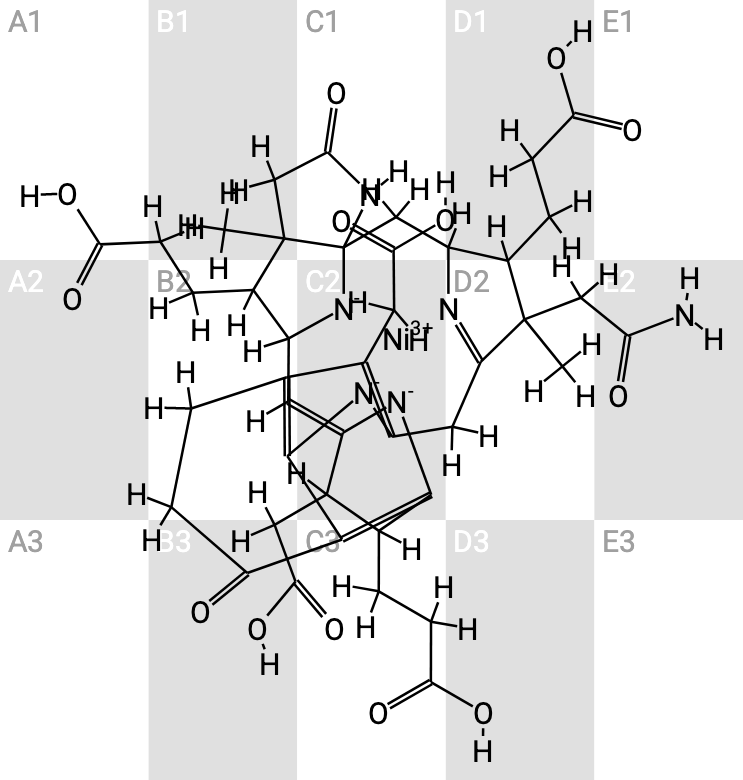
If you've ended up here, it's to solve a CAPTCHA that looks something like this:
The tool you need
CatMe0w/MolScribe-Long- Open it, upload your CAPTCHA screenshot, click Submit, and wait ten seconds.
- The "chiral carbons" will be marked with red dots. Compare against the problem and select the regions where the red dots fall.
- If a red dot lands right on a region boundary, try the adjacent regions one by one.
Some problems may have no solution — I'll explain that later. First, get past your CAPTCHA; it won't give you much time.
Did it work?
Let me guess — maybe you passed on the first try, in which case you got lucky. Or maybe you ran into one of those images, like the one at the top of this page, where the letters and lines are all piled on top of each other, and you had to retry several times just to roll the dice. Or, of course, maybe... you gave up.
By now you can probably sense, faintly, what "some problems may have no solution" really means.
Here's how it works: take a molecule from a proper molecular database, strip out its stereochemistry by force, stuff it full of redundant hydrogen atoms, and draw it into a tangle of "molecular structure" that no longer means anything.
Anyone who has studied real organic chemistry beyond high school can tell at a glance that these images are nonsensical, but the designers and users can't — because stereochemistry isn't on the syllabus of China's high school chemistry. They know the words "chiral carbon," but it never even occurred to them to ask whether these images are actually correct.
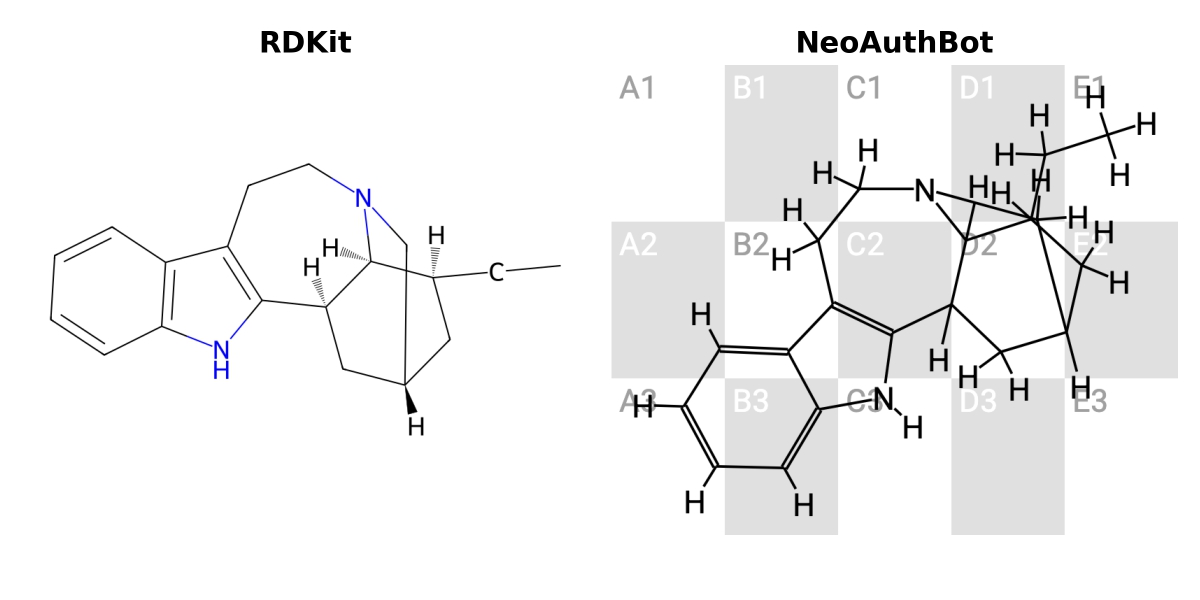
Looking at the right image alone, what structure is this, exactly? Only heaven knows.
You might want to ask: so why does anyone still use this thing?
They'll tell you: in the version most groups use, the correct answer has an asterisk next to it, marked right on the image. That mis-drawn molecular diagram you just struggled to make out? In those groups you don't even need to understand it. You only need to find where the asterisk is.
But a question with the answer written on the page — is that still a CAPTCHA? It isn't testing your knowledge, nor is it confirming that you're human. Its only purpose is to make you perform an unusual action. You don't know what it is, you don't understand why you have to do it, but you do it anyway — or you don't, and you're shut out.
They don't care. They just want you to do as you're told, to fumble your way through some clique's arcane rules you don't understand. Your bewilderment is itself exactly what they want.
So what is it really for? The answer is all but obvious now.
The group you just joined does not welcome you.
The next time you see the same thing somewhere else, you'll know what it is.
Credits
This project is directed by catme0w — he's an orange cat.
Demo code by @AsterTheMedStu, a seeker of MSc, adrift too far in the silver-shadowed realm of thinking machines.
The copy on this page (2025) was written by me, @oceancat365 (no, I'm not a cat; I'm a dog), later revised by catme0w; the 2026 version was written by catme0w.
Thanks to everyone who contributed to the design and discussion. And thank you for reading. Come say hi!